Case study · Climate Tech · Market Intelligence · AI
Transforming complex climate-tech data into actionable intelligence
Designing an AI-powered market intelligence platform that connects LLMs, proprietary data, evidence, and human judgement to transform complex research into actionable intelligence.
Overview
Market intelligence for the net-zero economy
Net Zero Insights (NZI) is a climate-tech market intelligence platform that helps investors, corporations, policymakers, and advisors understand the rapidly evolving net-zero economy.
The platform brings together intelligence across 152K+ companies, 136k+ funding rounds, 50k+ investors and across technologies, markets, company metrics, maturity stages, and other dimensions of the climate-tech ecosystem.
Users rely on this intelligence to
- Discover companies
- Evaluate markets
- Benchmark competitors
- Track investment activity
- Identify opportunities
- Understand emerging technologies
- Support strategic decisions
The challenge
The depth of its data made research complex
NZI's greatest strength was also one of its biggest UX challenges: the depth of its data made research complex.
A seemingly simple question could require users to navigate thousands of companies, multiple datasets, funding information, technologies, geographies, market categories, and underlying sources.
The opportunity was not simply to make the interface easier to use.
It was to reduce the distance between a research question and a confident, decision-ready answer.
This meant evolving NZI from a product where users primarily navigate and analyse data into one where they could ask questions, investigate markets, compare companies, and generate structured intelligence.
The product opportunity
A more direct path from question to decision
Traditional market research often follows a familiar pattern
- 1Navigate
- 2Filter
- 3Compare
- 4Interpret
The opportunity with AI was to create a more direct path
- Ask
- 2Investigate
- 3Verify
- 4Compare
- 5Decide
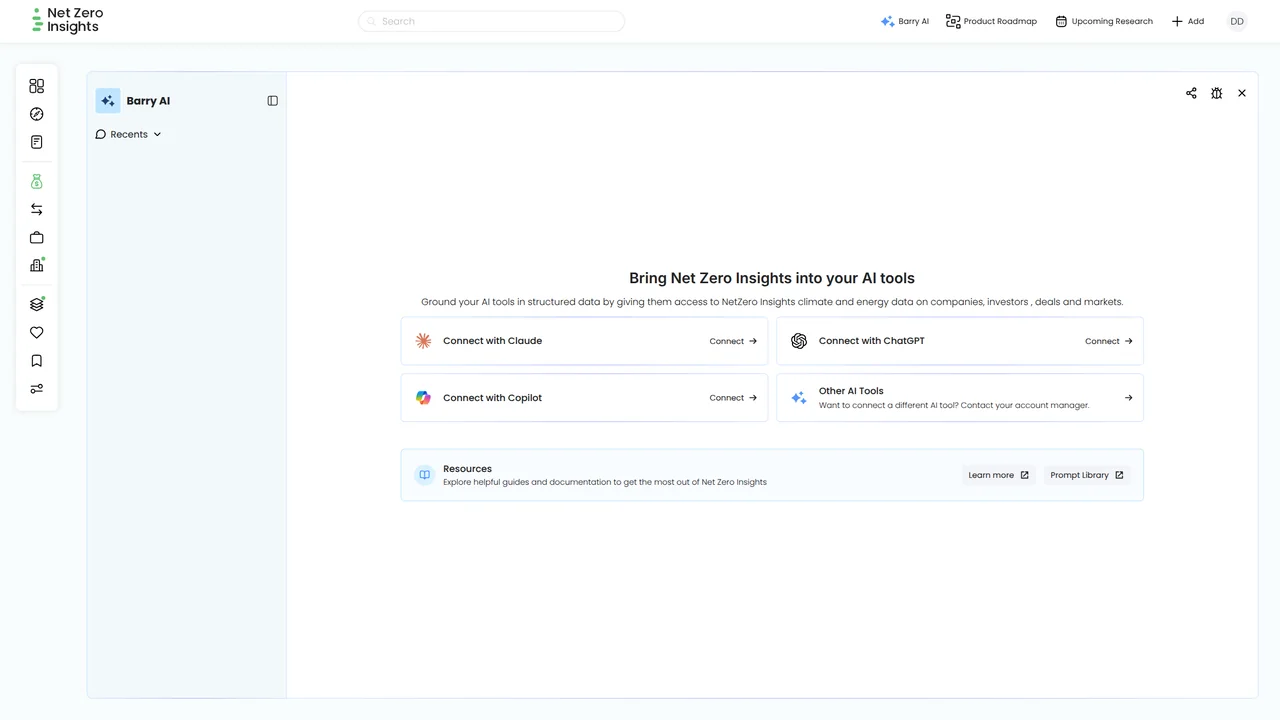
Barry AI
Designing an AI-native research experience
One of my key areas of work was Barry, NZI's AI research assistant.
The objective was not to add a chatbot to an existing product. It was to introduce an intelligence layer that could:
- Understand natural-language intent
- Query NZI's proprietary data
- Guide users through research workflows
- Generate structured outputs
- Surface supporting evidence
- Keep users in control of the research process
Company shortlisting
Turning natural-language intent into structured company discovery
NZI's extensive company database creates a common discovery problem: users often know what they are looking for, but not how their intent maps to the database's underlying structure.
Traditionally, answering this question could require configuring multiple filters manually. Barry could interpret the request and translate it into structured search criteria.
Key design considerations
The experience required careful handling of
- AI interpretation
- Loading and processing states
- Structured filter presentation
- Query refinement
- Result relevance
- Empty and low-confidence states
- AI-generated versus user-defined criteria
The underlying principle was simple
The AI should accelerate the researcher's work without hiding the logic behind the result.
From finding companies to identifying the right ones
Barry's Shortlist workflow
Discovery was only the first step. Users often needed to determine which companies were actually relevant to their research objective.
I worked on Barry's Shortlist workflow, allowing users to:
- Generate a company set using natural language
- Evaluate relevance
- Add companies to a shortlist
- Exclude companies
- Mark companies where relevance was uncertain
- Move directly into a comparison workflow
Compare companies
Turning AI research into structured competitive intelligence
Competitive analysis is a recurring workflow for investors, strategy teams, innovation teams, and climate-tech researchers.
I worked on the Compare Companies workflow to transform AI-generated research into a structured comparison rather than returning a large block of conversational text.
Users could select companies manually or start from an existing shortlist. They could then choose comparison dimensions from NZI's existing data model or define their own criteria.
Barry generated a structured comparison across dimensions such as
Designing a scalable comparison model
Companies as rows, criteria as columns
I structured the experience around a familiar research model, which allowed the comparison to scale naturally as users added more companies or criteria.
However, the table was more than a presentation layer. Each cell could expose the source supporting the information. This turned the output from a simple AI response into a research artifact that could be inspected and verified.
Designing trust into AI-powered research
Information is only useful when users can understand its provenance
For a market intelligence platform, users don't only need to know
“What does this data point say?”
They also need to know
“Where did this information come from?”
For example, Maturity Stage → Scaling could be supported by one or multiple underlying sources.
Beyond Barry
From large datasets to useful patterns, comparisons, and decisions
My work extended beyond AI into NZI's broader company and market intelligence experiences.
The goal was consistent across these experiences: help users move from large datasets to useful patterns, comparisons, and decisions.
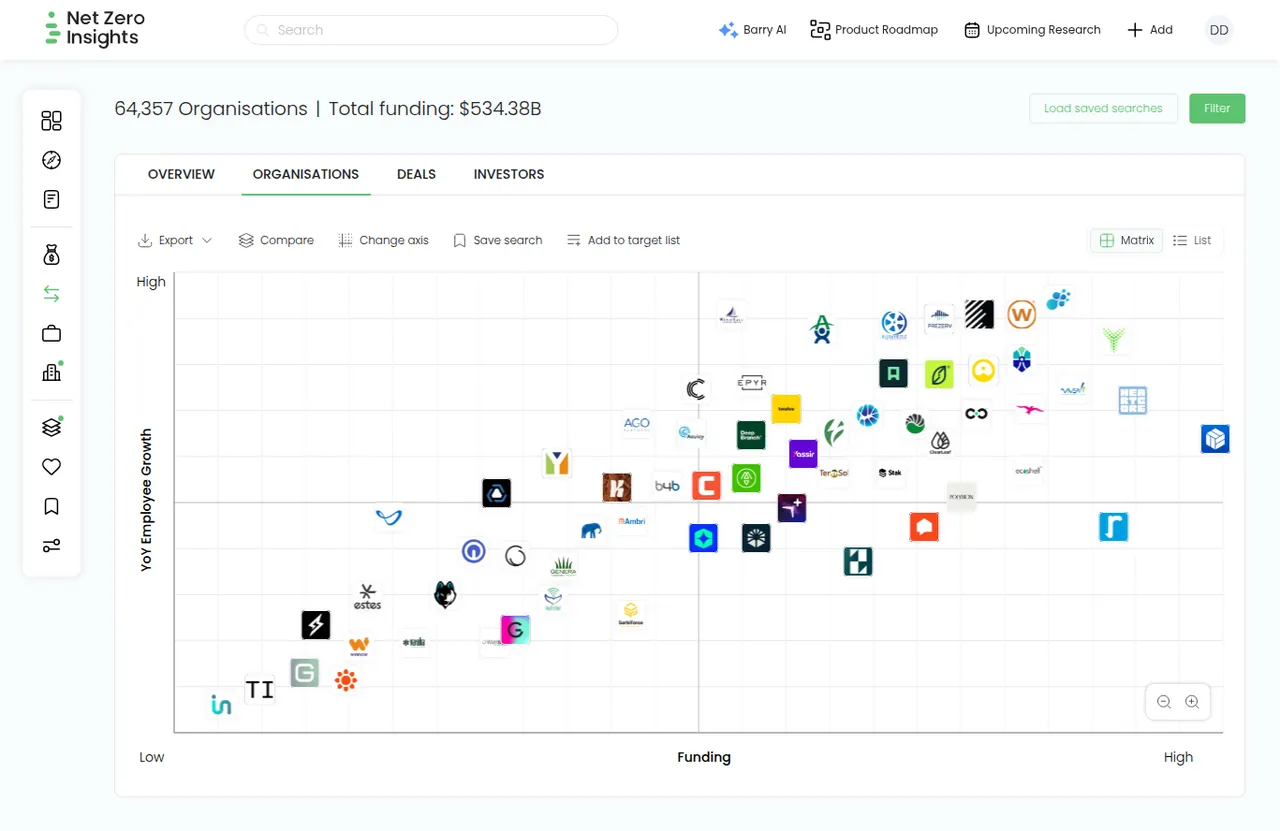
Performer Matrix
Making company performance easier to explore visually
The Performer Matrix allows users to evaluate companies across two custom dimensions using a visual matrix. Users can define the metrics they want to compare and visually map companies across those dimensions.
This creates a faster way to identify
Instead of reviewing company records one by one, users can explore relationships across a market at a glance.
Pathways
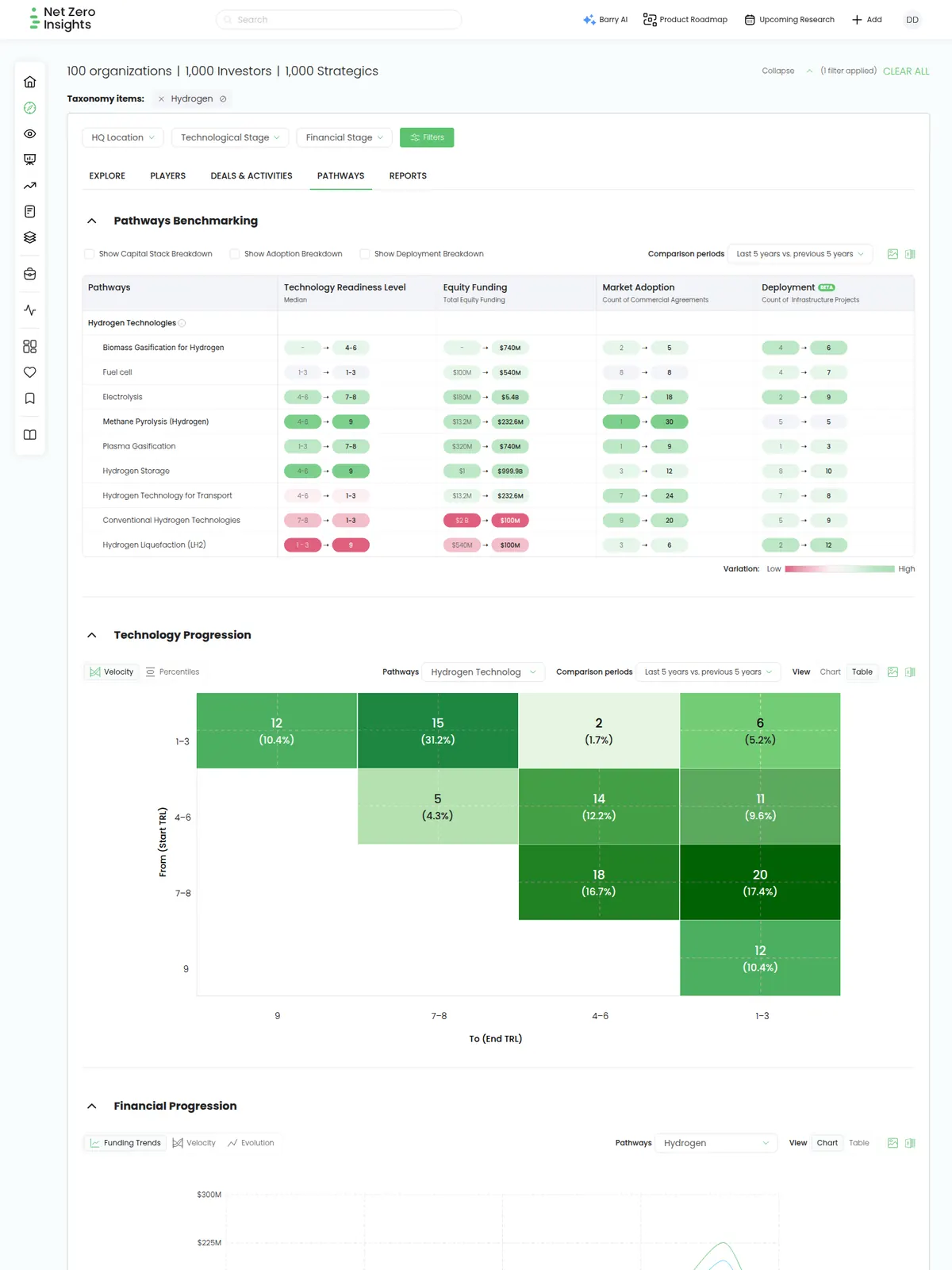
Understanding how climate technologies evolve
Pathways helps investors, corporates, and advisors understand how climate-technology sectors develop over time.
The experience combines historical data, statistical analysis, and visual exploration to help users understand both the technological and financial progression of climate sectors.
Users can explore the progression of technologies across different periods and investigate
The design challenge was to make complex time-based information understandable without oversimplifying the underlying data.
01Simplify complexity
I translated complex datasets and research workflows into experiences that users could understand without needing to understand the underlying data architecture.
The objective was not to hide complexity. It was to progressively reveal it when users needed it.
02Design workflows, not screens
I approached each feature as part of a larger research journey:
- Research question
- Investigation
- Evidence
- Insight
- Decision
This helped ensure that individual interfaces contributed to a coherent end-to-end workflow rather than functioning as isolated screens.
03Design AI with transparency
AI required more than conversational UI. The experiences needed to communicate:
- What the AI understood
- What it found
- Why it produced the result
- Where the information came from
- What the user could change
This allowed AI to accelerate research without becoming a black box.
04Build scalable interaction patterns
NZI contains many datasets, dimensions, and research workflows. I therefore focused on reusable interaction patterns rather than solving every feature independently. Examples included:
These patterns could extend across multiple parts of the product as the platform evolved.
05Connect user value to product value
The design work balanced two outcomes:
Help users research faster and make more confident decisions
whileincreasing the accessibility and usefulness of NZI's underlying intelligence.
The value of the platform was not simply the amount of data it contained. It was how effectively users could turn that data into something useful.
Outcome
AI as a new interaction layer, not a standalone feature
My work helped shape a product direction where AI was not treated as a standalone feature, but as a new interaction layer across NZI's intelligence platform.
The experience moved toward a more fluid research model. This created a foundation where users could combine the speed of AI with the structure, transparency, and evidence expected from a professional market intelligence platform.
Key design outcomes
- Introduced natural-language workflows for structured company discovery
- Connected AI interpretation with editable database filters
- Designed AI-assisted company relevance evaluation without false numerical precision
- Created structured AI-generated company comparisons
- Made data provenance directly accessible from research outputs
- Designed an interaction model that separates source inspection from data editing
- Created visual tools for exploring company performance and market evolution
- Established reusable interaction patterns for AI and data-heavy workflows
The takeaway
The central challenge at NZI was not simply making a complex product easier to use. It was designing a system where AI, data, evidence, and human judgement could work together.
The principle behind my work was simple:
Make complex intelligence easier to explore, understand, verify, and act on.
- Explore
- Understand
- Verify
- Act on
For me, that meant treating AI as more than an interface.
It meant designing the relationship between intelligence and the person using it.
Other case studies
More work